Pekkavee sanoi:
Noinhan se juuri on. Tilavuus ei muutu siellä kuulaventtiilin alla olevassa piirissä, kun venttiili on suljettuna. Neste on vaan eri paikoissa. Eli jarrusatuloiden männät painuvat sisään, kun ABS mäntä antaa tilaa. Ja jarrutusteho pienenee. Paine kyllä muuttuu, koska siihen vaikuttaa jarrupalojen paine jarrusatuloiden mäntiä kohti. Jos jarrutusta taas tarvitaan ABS yksikkö nostaa painetta, mutta ei se ole mikään pumppu. Se on paineen säädin.
Pumppu on laite, joka siirtää nestettä tai muuta pumpattavaa materiaa paikasta toiseen.
Katso tuolta mikä on pumppu
Ehkä me molemmat ymmärretään miten toi toimii. Erilainen näkemys on vaan siitä onko se pumppu vai ei.
Ja mikä on oikeasti yksitoiminen pumppu. En ymmärrä. Google ei sellaista löydä.
Ehkä tästä on nyt kuitenkin turha jatkaa kinastelua kunhan se ABS vain toimii. Ja yleensä se toimii.
Pekka

Kannattaa Töpinän lukea tää PekkaVeen selostus ajatuksen kanssa. Juuri noin se toimii. Kun tilavuus siellä ABS-yksikössä nousee, "siirtyy" paine/neste jarrujen työsylintereistä poispäin juuri tarpeeksi, jotta jarru hellittää.
Se ei ole pumppu vaan moduloi jarrupiiriä. Kaikessa kirjallisuudessa ja oppaissa puhutaan modulaattorista, ei pumpusta.
Tuossa vielä selostusta toimintaperiaatteesta "Länsi-Savoksi"
"...
General Description of How the ABS Control System Works:
The closed-loop control circuit consists of signal processing by the sensors and automatic control electronics which activate the electro-motor-powered pressure modulator in the event of overbraking by the wheel.
If the ABS control unit detects that wheel locking is about to take place on the basis of impulses being received from the rotating-speed sensors, it activates the motor of the clutch shaft. At the same time, the electro-magnetically controlled friction clutch of the respective brake circuit mounted to the clutch shaft is activated.
Depending on the frictional torque generated by the control unit in this clutch, the plunger piston in the pressure modulator is pulled downwards against a spring resistance by a precisely defined amount.
The resulting enlarged volume above the plunger piston results in the pressure decrease required in the brake circuit. At the same time, the movement of the reciprocating piston is recorded by the displacement sensor and forwarded to the ABS control unit, which obtains the information needed concerning the position of the piston in this manner and thus has a reference as to the relative brake pressure in the brake circuit. This scanning takes place within the closed-loop range every 8 ms and in the open-loop range every 4 ms.
The wheel is optimally decelerated just below the locking limit. This control sequence is repeated every time the wheel is on the verge of locking.
This system is the first system to enable recognition of the relative pressure by virtue of the displacement sensor of the reciprocating piston, with its corresponding position consequently making it possible to operate the motorcycle in accordance with any brake pressure curve in keeping with the respective riding conditions.
Based on the rotating-speed information coming from both wheels, this system is also capable of detecting lifting of the rear brake when the brakes are fully applied and preventing th is by correspondingly regulating the pressure in the front wheel brake circuit.
Owing to the fact that this system employs a plunger piston, the brake pressure can be decreased to 0 bar, thus ensuring dependable control behaviour on difficult riding surfaces, e.g. black ice, gravel etc.
..."


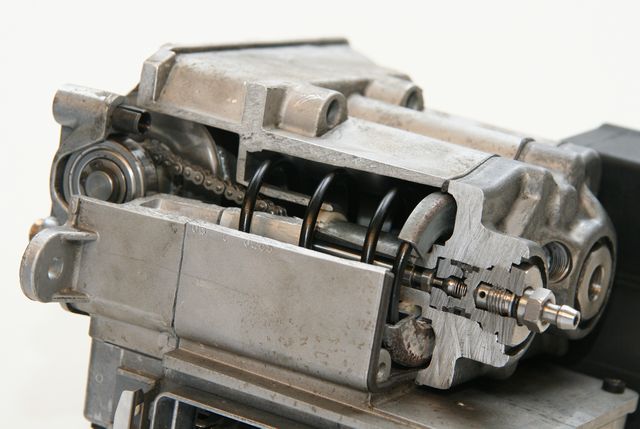


 ABS II:ssa, jossa ei ole servoja ja joka ei ole pumppu, se paine nousee takaisin jarrusatulaan kun magneettikytkin jolla ABS-yksikössä olevaa mäntää vedetään alas jousta vastaan, päästää ja mainittu jousi paukkaa sen männän takaisin ylös. Se jousi on mallia "hitonmoinen".
